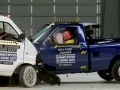
New crash tests and analysis by the Insurance Institute for Highway Safety demonstrate that underride guards on tractor-trailers can fail in relatively low-speed crashes -- with deadly consequences. The Institute is petitioning the federal government to require stronger underride guards that will remain in place during a crash and to mandate guards for more large trucks and trailers.
Sixty-six vehicles earn the Insurance Institute for Highway Safety’s TOP SAFETY PICK award for 2011, including 40 cars, 25 SUVs, and a minivan. TOP SAFETY PICK recognizes vehicles that do the best job of protecting people in front, side, rollover, and rear crashes based on good ratings in Institute tests. Winners also must have available electronic stability control, a crash avoidance feature that significantly reduces crash risk. The ratings help consumers pick vehicles that offer a higher level of protection than federal safety standards require.
Bumpers are the first line of defense against costly damage in everyday low-speed crashes. Bumpers on cars are designed to match up with each other in collisions, but a long-standing gap in federal regulations exempts SUVs from the same rules. New Insurance Institute for Highway Safety crash tests demonstrate the results: SUV bumpers that don’t line up with those on cars can lead to huge repair bills in what should be minor collisions in stop-and-go traffic.
Anyone who leans out the window, should know what he does. Tests have shown that riders who lean in motorcades from sides or roof windows, have to expect in case of accidents with fatal injuries.
More states are allowing a relatively new breed of vehicle on public roads, but crash tests by the Insurance Institute for Highway Safety show why the mix of low-speed vehicles (LSVs) or minitrucks and regular traffic is a deadly combination. LSVs are designed for tooling around residential neighborhoods, and minitrucks are for hauling cargo off-road. While these vehicles have a lot of appeal as a way to reduce emissions and cut fuel use, they don't have to meet the basic safety standards that cars and pickups do, and they aren't designed to protect their occupants in crashes.
As most high school and college students are busy tackling tests or taking it easy during spring break, student teams from across the Americas are preparing for the ultimate extracurricular activity – designing, building, and testing a vehicle that travels the farthest distance using the least amount of energy. After months of coordinating designs and constructing vehicles, 43 student teams – among 9 high schools and 29 universities – are putting the finishing touches on their vehicles for the 2010 Shell Eco-marathon Americas energy challenge. These leaders of tomorrow, and their fuel-efficient creations, will soon take to the streets of downtown Houston, March 26-28 around Discovery Green Park. We’ll find out if these students can beat the 2,757.1 miles per gallon (1,172.2 kilometers per liter) achieved in 2009 by Laval University, but more than that, the students will grant us a glimpse into the fuels, technologies and transportation of tomorrow.
To view Multimedia News Release, go to http://multivu.prnewswire.com/mnr/shelloil/42793/
With the famous Dakar Rally, unquestionably the toughest motor race in the world, it's first and foremost all about getting through, for both people and material. And even when we as normal car drivers don't directly profit from the sometimes unbelievable performances of the racing drivers, we at least benefit from the experience gained from the racing cars and their components. Each part, from the smallest screw up to a twin turbo fuel injection system, is subjected to the very toughest of tests during the Dakar Rally. And such components have to supply a maximum of performance – after all, for the teams it's all about winning. At the end of the rally the engineers know a whole lot more, yet again: knowledge invested in the construction of Golf & Co.
Dason and Chris, two young Hong Kongers now studying in American universities, talk about their experience preparing for their standardized tests at the Princeton Review in Hong Kong. For more information, go to the Princeton Review blog at http://blog.princetonreviewhk.com
You've spent months slogging over mock tests and practice sheets and now that CAT is just 2 weeks away. These two weeks are the last lap of preparation in a long journey. Handle it right and you will be in peak form for the mother of all tests.