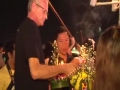
Bangkok’s Chao Praya river is seeing thousands of local and foreign visitors gathering along it again, all enjoying the usual Loy Krathong’s festive atmosphere which was absent last year due to the severe flood. And among the highlighted spots on the river, Asiatique the Riverfront Entertainment Complex seems to be hosting the grandest happenings with several shows and firework, making the area the most crowded place in the city.
LG Electronics and Tribeca Flashpoint Media Arts Academy previewed new 3D short films during the 10th Annual Tribeca Film Festival in New York City. Helping to drive the emerging 3D genre forward, Tribeca Flashpoint students and faculty developed this content as part of a unique program supported by LG to help provide the next generation of filmmakers with the experience they need to develop creative materials in this new medium.
To view Multimedia News Release, go to http://multivu.prnewswire.com/mnr/lg-one/49898/
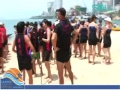
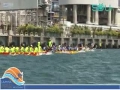
It is that time of year for the Dragons to emerge. Dragon boats that is.The SO-U.TV Asia2Extreme team went to the International Dragon Boat Festival Sunday, May 11. The event was held at Tai Wan To Beach (Power Station Beach), and attracted dragon boat teams and fans from as far away as Dubai. Check out http://www.so-u.tv/playVideo.php?id=621 for the highlights of the day.
The Lamma Dragons and Thirsty Horse have outdone themselves again as they hosted the 4th Annual Lamma 500. International Dragon Boat Festival at Tai Wan To Beach, Lamma Island, on Sunday, May 16th 2010. The Lamma Dragon Boat Festival has always been a popular attraction in the vibrant city of Hong Kong. This year, SOU-TV was the official media sponsor for the festival and we are happy to tell you that we have captured the most exciting highlights of the races right here!
Lamma Dragon Boat Race, The toughest race on the calendar 40 Men’s, Women’s and Mixed teams compete over the full international 500-metre length course in the \
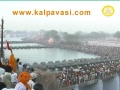
Kumbha (Kumbh) Mela is a mass pilgrimage centered on the ritual of riverside bathing, it is variously called the the Great Indian Bathing Festival, the Urn Festival, the Pitcher Festival and so forth. It occurs four times every twelve years rotating between Allahabad/Prayaga at the confluence of the rivers Ganga (Ganges), Jamuna (Yamuna) and the concealed Saraswati, Haridwar (Hara Dwar) on the river Ganga (Ganges), Ujjain on the river Kshipra (Shipra), and Nasik on the river Godavari (Gomati)
Bathing in these rivers during the Kumbha (Kumbh) Mela is considered an endeavour of great merit, cleansing both body and spirit. The Allahabad and Haridwar (Hara Dwar) festivals are routinely attended by five million or more pilgrims; the Kumbha (Kumbh) Mela is the largest religious gathering in the world. It may also be the oldest
Two traditions are in circulation regarding the origin and timing of the festival: one that stems from ancient texts known as the Puranas, and the other that connects it with astrological considerations. According to the Puranic epic, the gods and demons had churned the milky ocean at the beginning of time in order to gather various divine treasures including a jar containing a potion of immortality - Ambrosia. As the jar emerged from the ocean the gods and demons began a terrific battle for its possession. During the battle, which according to one legend the gods won by trickery, four drops of the precious potion fell to earth, when Jayantha (Jayanth) the son of the chief deity Indra carried the jar (Kumbha/kumbh) that held the ambrosia in the form of a giant bird - these places became the sites of the four Kumbha (Kumbh) Mela festivals, according to another legend he ran away with the jar and hid them on twelve locations on earth where few drops of ambrosia fell, four of these places are known and identified as the four sites for the Kumbh (Kumbh) Mela, the other eight locations are being researched by our team
The astrological tradition (ascribed to a lost Puranic text and not traceable in extant editions) seems to stem from a very ancient festival called the Kumbha Parva, which occurred at Hardwar every twelfth year when Jupiter was in Aquarius (the Indian name being Kumbha/Kumbh) and the sun entered Aries
At some later time the term 'Kumbha (Kumbh)' was prefixed to the Melas held at Prayaga, Ujjain, and Nasik and these four sites became identified with the four mythical locations of the immortality potion - Ambrosia. In theory the Kumbha (Kumbh) Mela festivals are supposed to occur every three years, rotating between the four cities. In practice the four-city cycle may actually take eleven or thirteen years and this because of the difficulties and controversies in calculating the astrological conjunctions. Furthermore the interval between the Kumbha Mela at Nasik and that at Ujjain is not of three years; they are celebrated the same year or only a year apart. This deviation in practice is intriguing and cannot be fully explained by either astrological or mythological means.
kalpavasi.com
Kumbha (Kumbh) Mela is a mass pilgrimage centered on the ritual of riverside bathing, it is variously called the ‘the Great Indian Bathing Festival’, ‘the Urn Festival’, ‘the
Pitcher Festival’ and so forth. It occurs four times every twelve years rotating between
Allahabad/Prayaga at the confluence of the rivers Ganga (Ganges), Jamuna (Yamuna) and the
concealed Saraswati, Haridwar (Hara Dwar) on the river Ganga (Ganges), Ujjain on the
river Kshipra (Shipra), and Nasik on the river Godavari (Gomati)
Bathing in these rivers during the Kumbha (Kumbh) Mela is considered an endeavour of
great merit, cleansing both body and spirit. The Allahabad and Haridwar (Hara Dwar)
festivals are routinely attended by five million or more pilgrims; the Kumbha (Kumbh)
Mela is the largest religious gathering in the world. It may also be the oldest