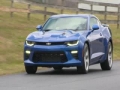
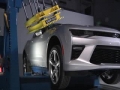
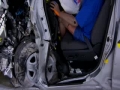
Think “muscle car” performance, and images of speed and power are more likely to come to mind than crash tests and safety ratings. Because no one buys a sports car to drive in the slow lane, the best all-¬ around occupant crash protection is crucial. The Insurance Institute for Highway Safety (IIHS) recently put a trio of iconic sports coupes through their paces, and unlike more sedate sedans, none earns the scores needed to clinch a TOP SAFETY PICK award.
IIHS evaluated 2016 models of the Chevrolet Camaro, Dodge Challenger and Ford Mustang in the full battery of crashworthiness evaluations. The Mustang comes closest to earning TOP SAFETY PICK, while the Camaro falls shortin one category and lacks an available front crash prevention system. The Challenger is most in need of improvement.
To qualify for TOP SAFETY PICK, vehicles must earn good ratings in the small overlap front, moderate overlap front, side, roof strength and head restraint evaluations and have a basic-¬rated front crash prevention system. To qualify for the Institute’s highest award, TOP SAFETY PICK+, vehicles must earn good ratings in the five crashworthiness tests and an advanced or superior rating for front crash prevention.
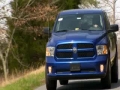
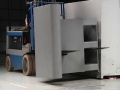
Three out of seven large pickup trucks evaluated by the Insurance Institute for Highway Safety in a new round of crash tests earn an acceptable or higher rating for occupant protection in a small overlap front crash.
IIHS evaluated two body styles of each 2016 model-year pickup — crew cab and extended cab. Crew cabs have four full doors and two full rows of seating. Extended cabs have two full front doors, two smaller rear doors and compact second-row seats.
IIHS last year decided it would test the two most popular variants of large pickups instead of just one after discovering that the Ford F-150 extended cab lacked structural countermeasures that helped the crew cab earn the top rating of good in the small overlap test. The test replicates what happens when a vehicle runs off the road and hits a tree or pole or clips another vehicle that has crossed the center line.
Ford improved the 2016 model F-150 SuperCab to clinch a good rating in the small overlap crash test, up from the 2015 model’s marginal rating. The F-150 is the only large pickup in the latest test group to earn the Institute’s top rating in the test. It joins the F-150 SuperCrew in earning a 2016 TOP SAFETY PICK award when equipped with Ford’s optional basic-rated forward collision warning system.
Vehicles that earn a basic rating for front crash prevention plus good ratings in the small overlap front, moderate overlap front, side, roof strength and head restraint evaluations qualify for TOP SAFETY PICK. To qualify for 2016 TOP SAFETY PICK+, a vehicle must earn good ratings in the five crashworthiness tests and an advanced or superior rating for front crash prevention.
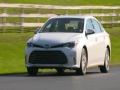
The Toyota Prius v is the only midsize car out of 31 evaluated to earn a good rating in the Insurance Institute for Highway Safety’s first-ever headlight ratings.
The best available headlights on 11 cars earn an acceptable rating, while nine only reach a marginal rating. Ten of the vehicles can’t be purchased with anything other than poor-rated headlights.
A vehicle’s price tag is no guarantee of decent headlights. Many of the poor-rated headlights belong to luxury vehicles.
The ability to see the road ahead, along with any pedestrians, bicyclists or obstacles, is an obvious essential for drivers. However, government standards for headlights, based on laboratory tests, allow huge variation in the amount of illumination that headlights provide in actual on-road driving. With about half of traffic deaths occurring either in the dark or in dawn or dusk conditions, improved headlights have the potential to bring about substantial reductions in fatalities.
According to a new survey from the American Institute of Certified Public Accountants (AICPA) and the Ad Council, one in three millennials (34 percent) ranked saving as their number one goal for the year – ahead of living a healthy lifestyle (20 percent), paying off debt (19 percent), and losing weight (14 percent). But while saving was a top priority, a majority of millennials attributed their lack of saving to impulse buying (65 percent).
For older millennials, those born between the early 1980’s and early 1990’s, saving is crucial as they work towards major milestones in their lives. When asked what they were saving money towards, respondents sought to secure their future by saving for an emergency fund (40 percent), saving for retirement (22 percent) or starting a family (15 percent). They also reported saving for larger purchases like a vacation (36 percent), a new house (27 percent), a car (26 percent), home improvements (20 percent), or a wedding (8 percent). To provide Americans aged 25 to 34 with the tips and tools to take control of their personal finances, AICPA and the Ad Council’s national advertising campaign, Feed the Pig, is continuing to collaborate with new partners to deliver this critical content in a relevant and engaging way.
“Many young adults think saving is impossible,” said Gregory Anton, CPA, CGMA, chair of the AICPA’s National CPA Financial Literacy Commission. “While low salaries and high debt levels can certainly be barriers to saving, the key is to create a budget and stick to it. Establishing a disciplined saving strategy early in life and avoiding missteps will reap substantial long-term dividends.”
To view the multimedia release go to:
http://www.multivu.com/players/English/7790851-ad-council-feed-the-pig/
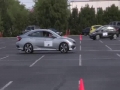
Spring is around the corner, and it won’t be long before it’s prom and graduation seasons for many high schoolers. Rites of passage for many, these are times for teens to celebrate, but can also be times of poor decision-making, especially when vehicles are involved. The National Highway Traffic Safety Administration (NHTSA) reports that 2,524 teen drivers and passengers were killed and 177,000 were injured in 2013. Twenty-seven percent of these fatalities occurred between April and June, according to the Insurance Institute for Highway Safety (IIHS).
“The statistics are staggering, especially when you consider that most of these accidents and fatalities are preventable,” said Randy Petro, Mercury Insurance’s chief claims officer. “We don’t want any families to suffer through the loss of a child, so Mercury is taking action with the launch of the ‘Mercury Insurance Drive Safe Challenge.’”
The Mercury Insurance Drive Safe Challenge kicked off with a free defensive driving program, which included hands-on driving skills training and classroom material. An interactive website provides teens with detailed instruction, as well as gives parents the tools to shape responsible driving behavior.
To view the multimedia release go to:
http://www.multivu.com/players/English/7772251-mercury-teen-drive-safe-challenge/
Nearly 50 vehicles meet tougher criteria for 2016 to take home the Insurance Institute for Highway Safety’s TOP SAFETY PICK+ award, earning good ratings in all five IIHS crashworthiness evaluations and an advanced or higher rating for front crash prevention. An additional 13 models qualify for TOP SAFETY PICK.
The baseline requirements for both awards are good ratings in the small overlap front, moderate overlap front, side, roof strength and head restraint tests, as well as a standard or optional front crash prevention system. The 48 winners of the “plus” award have a superior- or advanced-rated front crash prevention system with automatic braking capabilities. These vehicles must stop or slow down without driver intervention before hitting a target in tests at 12 mph, 25 mph or both. Models with a basic-rated front crash prevention system, which typically only issues a warning and doesn’t brake, qualify for TOP SAFETY PICK.
IIHS inaugurated TOP SAFETY PICK in the 2006 model year to help consumers home in on vehicles with the best safety performance. The TOP SAFETY PICK+ accolade was introduced in 2012 to recognize vehicles that offer an advanced level of safety.
“Want to enjoy life,” “like to learn things,” “look for adventures and like to take risks” – these traits tell the story of how Americans perceive entrepreneurs, as revealed in the 2015 Amway Global Entrepreneurship Report (AGER).
It’s an optimism that permeates the research again this year, with 86 percent of Americans expressing positive attitudes toward entrepreneurship, up a remarkable 24 percent from 2014 and a resounding 11 percent more than the 2015 global average (75 percent). Echoed by their strong desire for “independence from an employer” and “self-fulfillment, possibility to realize own ideas,” at 75 percent and 72 percent respectively, this positivity is indicative of the country’s thriving entrepreneurial spirit.
“The attitude toward entrepreneurship is not only remarkably high but significantly increased from last year when fewer than two-thirds of respondents reported a positive attitude,” notes Dr. David B. Audretsch, professor and director of the Institute for Development Strategies at the Indiana University School of Public and Environmental Affairs. “What’s more, the secondary importance of financial compensation contradicts the most prevalent stereotypes and myths about why people choose entrepreneurship.”
To view the multimedia release go to:
http://www.multivu.com/players/English/7402451-amway-ager-spirit-index/
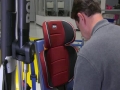
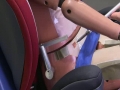
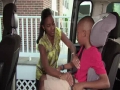
When IIHS began its booster seat ratings in 2008, most models failed to consistently provide good belt fit — the main purpose of a booster. This year, all new models evaluated by the Institute provide good or acceptable fit for typical 4 to 8 year-olds in most cars, minivans or SUVs.
Out of 23 new models evaluated, 20 earn the highest rating of BEST BET, meaning they are likely to provide good fit for a 4- to 8-year-old child in almost any car, minivan or SUV. Another three models are rated GOOD BETs, meaning they provide acceptable fit in most vehicles. There are no new models in the Not Recommended category, nor are there any with the Check Fit designation, which identifies seats that may work for some children in some vehicles.
The Obama administration is holding the White House Summit on Nuclear Energy today discussing the role of nuclear energy in reducing carbon emissions linked to the threat of climate change. The event will be live streamed on WhiteHouse.gov and YouTube beginning at 1 p.m. ET.
“Nuclear energy has a really important role to play in the fight against climate change, and I think administrations in the past have recognized this but they’ve tended to be kind of quiet about it,” said Eileen Claussen, founder of the Pew Center on Global Climate Change.
To view the Multimedia News Release, go to http://www.multivu.com/players/English/7677651-nei-nuclear-energy-summit/
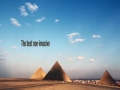
The Egyptian Ministry of Antiquities is pleased to announce the launch of an egyptian – international Project using non-invasive and non-destructive surveying techniques for the scanning of Egyptian Pyramids under the title “ScanPyramids” project.
Just because a mystery is 4500 years old doesn’t mean it can’t be solved…” This could be the motto of the exceptional scientific mission launched October 25, 2015, under the authority of the Egyptian Ministry of Antiquities, initiated, designed and coordinated by the Faculty of Engineering of Cairo and the French HIP.Institute (Heritage, Innovation and Preservation). Radiographic muons, aka cosmic particles, infrared thermography, photogrammetry, scanner and 3D reconstruction: the most innovative technologies will be used by researchers of international renown and three major universities: the Faculty of Engineering of Cairo University, Université Laval of Quebec and Nagoya University of Japan. Their goal: to probe the heart of the largest pyramids of Egypt, without drilling the slightest opening.
Four millennia after their construction, these ancient giants are far from having yielded their secrets. The first mystery concerns their construction, especially Khufu, the last of the Seven Wonders of the Ancient World still existing: it is still impossible to describe with certainty how this stone monument, the largest ever built by humans, was erected.
The “ScanPyramids” project has already been approved by the permanent committee of the Ministry of Antiquities and has obtained all necessary permissions from concerned authorities. With a base of more than 5 hectares, its original height of almost 150 meters and a mass of 5 million tons, how was it possible to construct such a wonder in only 25 years?
To view the multimedia release go to:
http://www.multivu.com/players/uk/7671551-scanpyramids-project-launch-egyptian/
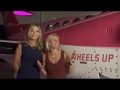
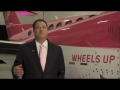
Wheels Up, the revolutionary membership-based private aviation company, officially unveiled the first-ever pink Beechcraft King Air 350i aircraft yesterday evening at the Westchester County Airport in White Plains, New York, in support of Breast Cancer Awareness Month. The event hosted by Kenny Dichter, Founder and CEO of Wheels Up, kicked off the #WheelsUpGoesPink campaign in support of the Company’s ongoing commitment to the Dubin Breast Center of The Tisch Cancer Institute at Mount Sinai in New York City, one of the world’s most renowned and advanced facilities for breast cancer treatment and research.
To view the Multimedia News Release, go to http://www.multivu.com/players/English/7628751-wheels-up-pink-plane/
The Leukemia & Lymphoma Society (LLS) today announced it has committed $28.6 million in new research investment to advance the most promising blood cancer science at leading academic and medical institutions around the world, including Dana-Farber Cancer Institute, Weill Cornell Medical College and MD Anderson Cancer Center. As LLS leads the charge to find cures for cancer patients, this new funding, along with ongoing investment in LLS’s aggressive research agenda, brings LLS’s total commitment to blood cancer research to more than $1 billion. The investment has led to the development of nearly every therapy currently used to treat the blood cancers.
Along with these new research grants, LLS remains committed to collaborating with biotechnology companies through its innovative Therapy Acceleration Program® (TAP), a model pioneered by LLS in the cancer arena in recognition that traditional research approaches weren’t yielding treatments and cures fast enough for patients. LLS commits approximately $13 million a year to its TAP initiatives. As part of the 24 current such collaborations, LLS recently initiated new investments with Kite Pharma and OncoPep.
To view the multimedia release go to:
http://www.multivu.com/players/English/7554852-lls-cancer-research-funding/