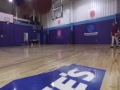
For millions of American kids and teens, back-to-school means more than class time, it also means ‘Club time’ as they spend after school hours at local Boys & Girls Clubs across the nation. This fall, Club members at 50 Boys & Girls Clubs – one in each state – will be greeted with refreshed, enhanced or expanded facilities as Lowe’s gives fifty $50,000 grants through Renovation Across the Nation, a $2.5 million initiative through its national partnership with Boys & Girls Clubs of America (BGCA).
Olympic gold medalist Dominique Dawes vaulted the program into the spotlight this morning, kicking off the initiative at one of the 50 Clubs, the Boys & Girls Club of Harlem in New York City. The nationwide revitalization effort will enhance both the environment and the experience for more than 50,000 Club members, driving new membership among kids and teens. Dawes, a long-time friend of Boys & Girls Clubs and a mother herself, understands the value of the Club experience in bringing hope and strength to kids and teens in need of a safe and inspiring place to go after school.
To view the multimedia release go to:
http://www.multivu.com/players/English/7906451-lowes-bgca-renovation-across-nation/
Today, the Ad Council in partnership with the U.S. Department of Health and Human Services, AdoptUSKids, and KBS launched new public service advertisements (PSAs) for the award-winning Adoption from Foster Care campaign. The new television and radio PSAs encourage the adoption of older youth from foster care.
Of the 428,000 youth under the age of 18 in the U.S. foster care system, 112,000 are currently waiting for adoptive families, according to the most recent Adoption and Foster Care Analysis and Reporting System (AFCARS) data. Since the project’s launch in 2002, more than 26,000 children who were once photo listed on the AdoptUSKids website have been placed with permanent families. However, older youth and teens have lower adoption rates than younger children, and they often wait longer to be adopted. Currently, of the 5,560 youth photo-listed on the website as available for adoption, 43% are between the ages of 15 and 18 years old.
To view the multimedia release go to:
http://www.multivu.com/players/English/7979251-ad-council-adoptuskids-adopt-from-foster-care/
Adults have gotten the message that it’s safer for kids to ride in the back seat properly restrained, but when it comes to their own safety, there is a common misperception that buckling up is optional. Among adults who admit to not always using safety belts in the back seat, 4 out of 5 surveyed by the Insurance Institute for Highway Safety say short trips or traveling by taxi or ride-hailing service are times they don’t bother to use the belt.
The new survey reveals that many rear-seat passengers don’t think belts are necessary because they perceive the back seat to be safer than the front. This shows a clear misunderstanding about why belts are important, no matter where a person sits in a vehicle.
Before the majority of Americans got into the habit of buckling up, the back seat was the safest place to sit, and the center rear seat was the safest place of all in 1960-70s’ era vehicles. In recent decades, high levels of restraint use, the advent of belt pretensioners, load limiters and airbags, plus crashworthy vehicle designs have narrowed the safety advantages of riding in the rear seat for teens and adults.
December 3rd 2017 marks the 25th anniversary of the text message and it’s hard to imagine a world without it. Since the first text was sent (“Merry Christmas”), billions of people around the world have used messaging as their preferred way to communicate. In fact, 80 percent of adults and 91 percent of teens message every day, according to a new global study commissioned by Messenger.
To view the multimedia release go to:
https://www.multivu.com/players/English/8227151-messenger-25th-anniversary-text-message/
The National Meningitis Association (NMA) today announced the launch of a new educational initiative in collaboration with Sanofi Pasteur, the vaccines division of Sanofi, about the importance of the Centers for Disease Control and Prevention’s (CDC’s) recommended second dose of the meningococcal meningitis vaccine (MenACWY) for adolescents at age 16. The 16 Vaccine (The16Vaccine.org) aims to educate parents about the importance of this critical second dose of MenACWY, which helps protect teens against meningococcal meningitis during the period when they are at increased risk.
To view the multimedia release go to:
https://www.multivu.com/players/English/8385951-national-meningitis-association-the-16-vaccine/