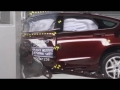
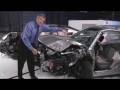
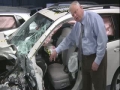
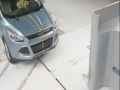
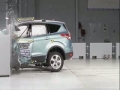
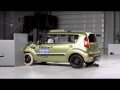
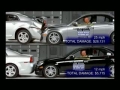
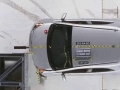
Drivers of vehicles that perform well in the Insurance Institute for Highway Safety's side-impact crash test are much less likely to die in a real-world left-side crash than drivers of vehicles that do poorly, a new analysis finds. The study includes only passenger vehicles with side airbags, demonstrating that airbags, while crucial, are far from the whole story in side crash protection.
After controlling for driver age and gender and vehicle type and weight, a driver of a vehicle rated good for driver protection in a side impact is 70 percent less likely to die in a left-side crash compared with a driver of a vehicle rated poor. A driver of a vehicle rated acceptable is 64 percent less likely to die, and a driver of a vehicle rated marginal is 49 percent less likely to die.
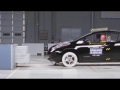
The Chevrolet Volt and Nissan Leaf earn the highest safety ratings from the Insurance Institute for Highway Safety in the first-ever U.S. crash test evaluations of plug-in electric cars. The milestone demonstrates that automakers are using the same safety engineering in new electric cars as they do in gasoline-powered vehicles.
The Volt and Leaf earn the top rating of good for front, side, rear, and rollover crash protection. With standard electronic stability control, they qualify as winners of TOP SAFETY PICK, the Institute’s award for state-of-the-art crash protection. The ratings help consumers pick vehicles that offer a higher level of protection than federal safety standards require.
An early crop of advanced crash avoidance technologies includes some clear success stories when it comes to preventing crashes, insurance claim analyses by the Highway Loss Data Institute (HLDI) show.
Forward collision avoidance systems, particularly those that can brake autonomously, along with adaptive headlights, which shift direction as the driver steers, show the biggest crash reductions. Lane departure warning appears to hurt, rather than help, though it’s not clear why, and other systems, such as blind spot detection and park assist, aren’t showing clear effects on crash patterns yet.
HLDI analysts looked at how each feature affected claim frequency under a variety of insurance coverages for damage and injuries. Clear patterns were seen in claims under property damage liability (PDL) insurance, which covers damage caused by the insured vehicle to another vehicle, and collision insurance, which covers damage to the insured vehicle. Frequency is measured as the number of claims relative to the number of insured vehicle years. An insured vehicle year is one vehicle insured for one year, two vehicles for six months, etc. The model years of the vehicles included ranged from 2000 to 2011, depending on when an automaker introduced a feature. Insurance data through August 2011 were used.
Only 3 of 11 midsize luxury and near-luxury cars evaluated earn good or acceptable ratings in the Insurance Institute for Highway Safety’s new small overlap frontal crash test, the latest addition to a suite of tests designed to help consumers pick the safest vehicles.
A group of moderately priced midsize cars outperformed most of their luxury counterparts in a challenging new frontal crash test conducted by the Insurance Institute for Highway Safety (IIHS) on 2013 models. Of the 18 midsize family cars evaluated in the small overlap test, two earn the top rating of good, 11 earn acceptable, three earn marginal, and two are poor.
In contrast, just 3 of 11 midsize luxury and near-luxury cars evaluated in the inaugural round of small overlap tests earned good or acceptable ratings. Midsize moderately priced cars are the second group to be tested. The best performers in this group are the Honda Accord 4-door and Suzuki Kizashi. Both earn a good rating.
The 2014 Subaru Forester is the first vehicle to ace every aspect of the challenging small overlap front crash test conducted by the Insurance Institute for Highway Safety (IIHS). The Forester, the only 1 of 13 small SUVs to earn an overall rating of good in the test, and the 2013 Mitsubishi Outlander Sport, which earns acceptable, are the latest vehicles to qualify for the Institute’s recently inaugurated top honor, TOP SAFETY PICK+. Each of the other 11 SUVs earns either a poor or marginal rating.
The latest small overlap front crash test results from the Insurance Institute for Highway Safety (IIHS) reveal a range of performance among many of the best-selling small cars in the U.S. market. Of the 12 models evaluated, half earn a good or acceptable rating and qualify for the IIHS TOP SAFETY PICK+ award.
The 2-door and 4-door models of the Honda Civic are the only small cars to earn the top rating of good in the test. IIHS evaluated the Civics earlier this year and released the results in March. The Dodge Dart, Ford Focus, Hyundai Elantra and 2014 model Scion tC earn acceptable ratings.
A new test program by the Insurance Institute for Highway Safety (IIHS) rates the performance of front crash prevention systems to help consumers decide which features to consider and encourage automakers to speed adoption of the technology. The rating system is based on research by the Highway Loss Data Institute (HLDI) indicating that forward collision warning and automatic braking systems are helping drivers avoid front-to-rear crashes.
The Chevrolet Equinox and its twin, the GMC Terrain, are the only midsize SUVs out of nine evaluated to earn a good rating in the Insurance Institute for Highway Safety’s small overlap front crash test, which continues to challenge manufacturers more than a year and a half after its introduction.
The Equinox and the Terrain qualify for the Institute’s highest award for 2014, TOP SAFETY PICK+. The Toyota Highlander, a midsize SUV whose acceptable small overlap rating was announced in December, also qualifies. The award is given to vehicles with a good or acceptable small overlap rating, good ratings in four other occupant protection tests, and a rating of basic or higher for front crash prevention.
Three other midsize SUVs in the test group rate poor for small overlap protection, and three are marginal.
The Mini Cooper Countryman is the only small car to earn a good rating among the latest group of 12 small cars subjected to the Insurance Institute for Highway Safety’s small overlap front crash test.
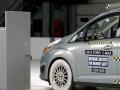
Two electric models and a hybrid are in the mix, with varied results. The electric-powered Chevrolet Volt (with a gasoline engine “range extender”) earns an acceptable rating, while its battery-electric rival, the Nissan Leaf, earns a poor rating. The Ford C-Max Hybrid, a small four-door wagon, earns an acceptable rating. Another small four-door wagon, the gasoline-powered Mazda 5, is rated poor.