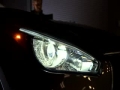
Consumers who choose a 2017 TOP SAFETY PICK+ award winner shouldn’t have trouble seeing the road on nighttime drives. Good or acceptable ratings in the Insurance Institute for Highway Safety’s new headlight evaluations set the latest crop of qualifiers apart. Thirty-eight models earn the “plus” accolade, and 44 earn TOP SAFETY PICK.
IIHS toughened the criteria for TOP SAFETY PICK+ to reflect new headlight evaluations launched in 2016. The recognition program is meant to encourage manufacturers to offer state-of-the-art protection for people in crashes, along with features that help drivers avoid crashes in the first place. In addition to good or acceptable headlights, the latter includes automatic braking technology, which has been part of the criteria since 2015.
For both awards, models must earn good ratings in the Institute’s small overlap front, moderate overlap front, side, roof strength and head restraint tests, as well as an advanced or superior rating for front crash prevention with standard or optional autobrake. Headlights are factored in only for the top award.
Adults have gotten the message that it’s safer for kids to ride in the back seat properly restrained, but when it comes to their own safety, there is a common misperception that buckling up is optional. Among adults who admit to not always using safety belts in the back seat, 4 out of 5 surveyed by the Insurance Institute for Highway Safety say short trips or traveling by taxi or ride-hailing service are times they don’t bother to use the belt.
The new survey reveals that many rear-seat passengers don’t think belts are necessary because they perceive the back seat to be safer than the front. This shows a clear misunderstanding about why belts are important, no matter where a person sits in a vehicle.
Before the majority of Americans got into the habit of buckling up, the back seat was the safest place to sit, and the center rear seat was the safest place of all in 1960-70s’ era vehicles. In recent decades, high levels of restraint use, the advent of belt pretensioners, load limiters and airbags, plus crashworthy vehicle designs have narrowed the safety advantages of riding in the rear seat for teens and adults.