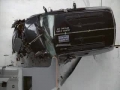
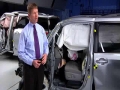
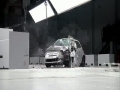
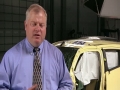
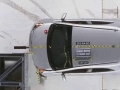
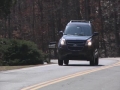
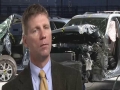
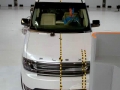
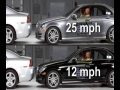
A group of four minivans recently tested by the Insurance Institute for Highway Safety for protection in small overlap front crashes shows some of the worst possible outcomes for this type of crash, with only one vehicle performing acceptably.
The Nissan Quest, the Chrysler Town & Country and its twin, the Dodge Grand Caravan, all earn poor ratings. The exception to the disappointing pattern is the 2015 Toyota Sienna, which earns an acceptable rating. It joins the Honda Odyssey, which last year earned a good rating in the test, in the ranks of TOP SAFETY PICK+ winners.
Only 1 minicar out of 11 tested achieves an acceptable rating in the Insurance Institute for Highway Safety's small overlap front crash test, making these tiny vehicles the worst performing group of any evaluated so far.
The Chevrolet Spark's acceptable rating in the test, along with good ratings in the Institute's four other crashworthiness evaluations, earns the new minicar a 2014 TOP SAFETY PICK award. The Spark was among the initial award winners announced in December. The new small overlap test results for the rest of the minicar group mean that no other models in this size category join the Spark in the winner's circle yet.
The Chevrolet Equinox and its twin, the GMC Terrain, are the only midsize SUVs out of nine evaluated to earn a good rating in the Insurance Institute for Highway Safety’s small overlap front crash test, which continues to challenge manufacturers more than a year and a half after its introduction.
The Equinox and the Terrain qualify for the Institute’s highest award for 2014, TOP SAFETY PICK+. The Toyota Highlander, a midsize SUV whose acceptable small overlap rating was announced in December, also qualifies. The award is given to vehicles with a good or acceptable small overlap rating, good ratings in four other occupant protection tests, and a rating of basic or higher for front crash prevention.
Three other midsize SUVs in the test group rate poor for small overlap protection, and three are marginal.
As part of National Teen Driver Safety Week, the National Highway Traffic Safety Administration and the Ad Council announced today their first national public service campaign designed to prevent underage drinking and driving. Following the success of iconic campaigns including “Friends Don’t Let Friends Drive Drunk” and “Buzzed Driving is Drunk Driving,” the new public service ads (PSAs) were unveiled this morning by Mark Rosekind, Administrator for the U.S. Department of Transportation’s National Highway Traffic Safety Administration (NHTSA), at the National Organizations for Youth Safety (NOYS) Teen Safe Driving Summit in Washington, DC.
“One teenage death from drinking and driving is too many,” said NHTSA Administrator Mark Rosekind. “Our goal with this campaign is to raise awareness among teenagers that drinking and driving is one of the worst mistakes they can ever make, with deadly consequences that can’t be undone.”
Motor vehicle crashes are the leading cause of death among teens in America, and almost half of teens killed in crashes are the drivers themselves. Despite a minimum legal drinking age of 21 in all 50 states, almost one-quarter of young drivers involved in fatal traffic crashes had alcohol in their systems according to data from NHTSA.
To view the multimedia release go to:
http://www.multivu.com/players/English/7662551-ad-council-ultimate-party-foul/
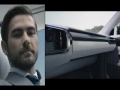
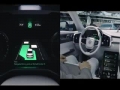
Volvo Cars is looking ahead to when its drivers can sit back and enjoy free time in their car on the daily commute.
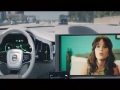
At the 2016 Consumer Electronics Show (CES) Volvo revealed that it is developing intelligent, high bandwidth, streaming capabilities with its technology partner, Ericsson, that will ensure drivers and passengers get the most out of their time travelling in an autonomous Volvo.
“We recently unveiled our design vision for fully autonomous cars with Concept 26. Now we are actively working on future solutions to deliver the best user experience in fully autonomous mode. Imagine a highway full of autonomous cars with their occupants sitting back watching their favourite TV shows in high definition. This new way of commuting will demand new technology, and a much broader bandwidth to ensure a smooth and enjoyable experience,” said Anders Tylman General Manager Volvo Monitoring & Concept Center at Volvo Car Group.
To view the multimedia release go to:
http://www.multivu.com/players/uk/7717751-volvo-ericsson-intelligent-media-streaming/
The Mini Cooper Countryman is the only small car to earn a good rating among the latest group of 12 small cars subjected to the Insurance Institute for Highway Safety’s small overlap front crash test.
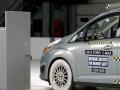
Two electric models and a hybrid are in the mix, with varied results. The electric-powered Chevrolet Volt (with a gasoline engine “range extender”) earns an acceptable rating, while its battery-electric rival, the Nissan Leaf, earns a poor rating. The Ford C-Max Hybrid, a small four-door wagon, earns an acceptable rating. Another small four-door wagon, the gasoline-powered Mazda 5, is rated poor.
New midsize SUV ratings from the Insurance Institute for Highway Safety show that headlights are improving when it comes to visibility, but many still need to do a better job of lighting the road ahead while limiting bothersome glare.
The 2017 Hyundai Santa Fe and the 2017 Volvo XC60 are the only models available with good-rated headlights among the 19 midsize SUVs and 18 midsize luxury SUVs evaluated in this new round of tests. Twelve SUVs are available with headlights rated acceptable, while 23 aren’t available with anything other than marginal- or poor-rated headlights.
The Toyota Prius v is the only midsize car out of 31 evaluated to earn a good rating in the Insurance Institute for Highway Safety’s first-ever headlight ratings.
The best available headlights on 11 cars earn an acceptable rating, while nine only reach a marginal rating. Ten of the vehicles can’t be purchased with anything other than poor-rated headlights.
A vehicle’s price tag is no guarantee of decent headlights. Many of the poor-rated headlights belong to luxury vehicles.
The ability to see the road ahead, along with any pedestrians, bicyclists or obstacles, is an obvious essential for drivers. However, government standards for headlights, based on laboratory tests, allow huge variation in the amount of illumination that headlights provide in actual on-road driving. With about half of traffic deaths occurring either in the dark or in dawn or dusk conditions, improved headlights have the potential to bring about substantial reductions in fatalities.
Three more midsize SUVs achieved good or acceptable ratings from the Insurance Institute for Highway Safety in the latest round of small overlap front crash testing, but many models, including three newly rated SUVs from Fiat Chrysler Automobiles and one from Hyundai, continue to struggle with the test.
Drivers of late-model pickup trucks are likely to find themselves squinting into the darkness or temporarily blinding other drivers, the Insurance Institute for Highway Safety's latest headlight ratings show.
All four small pickups evaluated are available only with headlights that earn a poor rating. The same goes for 3 out of 7 large pickups. Only one large pickup, the Honda Ridgeline, is available with good-rated headlights, though all but the most expensive trim levels come with poor ones.
Pickups are the third vehicle category to be put through the IIHS headlight evaluations. Midsize cars were the first in March, followed by small SUVs in July.
IIHS launched its headlight ratings after finding that government standards based on laboratory tests allow for huge variation in the amount of illumination headlights provide in on-road driving. In the Institute's evaluations, engineers measure how far light is projected from a vehicle's low beams and high beams as the vehicle travels straight and on curves. Glare from low beams for oncoming drivers also is measured.
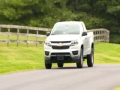
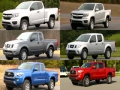
Four out of eight small pickup trucks evaluated by the Insurance Institute for Highway Safety earn good ratings for occupant protection in all five IIHS crashworthiness evaluations, but the lack of an automatic emergency braking system and poor-rated headlights means these pickups fall short of qualifying for either of the Institute’s safety awards.
IIHS engineers evaluated two body styles of each pickup — crew cab and extended cab. Crew cabs have four full doors and two full rows of seating. Extended cabs have two full front doors, two smaller rear doors and compact second-row seats. The Institute tests the two most popular versions of pickups because their performance can vary by body style. The ratings in this round of evaluations apply to 2017 models.
Less than a year into a new Insurance Institute for Highway Safety ratings program for front crash prevention, auto manufacturers are making strides in adopting the most beneficial systems with automatic braking capabilities and are offering the features on a wider variety of models. Twenty-one of 24 cars and SUVs, all 2014 models unless noted, earn an advanced or higher rating in the latest round of IIHS evaluations.