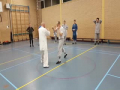
As a student of Shi Su Gang aka Shi Sugang master Giel Puts practised the way of Shaolin. He also did other arts like Shaolin kempo and Yang Style Tai Chi Chuan. He taught a Yang Tai Chi Swordn form and Selfdefense according Luohan style. This workshop was held by Giel Puts in Apeldoorn the Netherlands. Giel Puts also has his own Martial Arts Academy Luohan Fangfa Roermond.
Shifu Giel Puts was a student of famous Iron Head warrior Monk Shi Su Gang also known as Shi Sugang. He runs his own martial arts school in Roermond the Netherlands and he conducted this selfdefense workshop of Shaolin martial arts
Anyone who has seen the blockbuster movies The Thomas Crown Affair or Bullitt will want to read The Pursuit of Happiness, a new novel by the same writer, Alan Trustman. The highest paid screenwriter in Hollywood at one time, Trustman now turns his pen to fiction, which reads and moves with the same crime thriller speed as his movies.
From the opening chapter we are rocketed into the world of a Boston bad boy who is recruited to work for the government.
“All of the material in The Pursuit of Happiness is true,” says Trustman. “Not a lot of people know that Boston was the contract killing capitol of the country throughout the 1940s – 1970s. Maybe later. I did a lot of research on the Boston gang wars.”
Media Contact: For a review copy of Silver Dollar or to arrange an interview with Alan Trustman, contact Scott Lorenz of Westwind Communications Book Marketing at scottlorenz@westwindcos.com or by phone at 734-667-2090 http://www.book-marketing-expert.com Thriller
Please support! Metanoia Us
Spoken Word Written by Zuhayr Essenouni & Mounir
This spoken word is about how some young boys are enticed into gang life due to the lack of choice. Their upbringing saw this as the only option. They didn't find acceptance in school or home but got respect from gang members. They felt like they were part of something bigger than themselves. I also try to depict how they don't really care about you and the only aim is making money. so when you do slip up or make a mistake they will turn on you. The final part is about regretting what you did and wanting to change. This is a 100% guarantee for all gang members. There will come a time where it is either love, family or moral/ ethical reasons to stop. one way or another all gang members realise that the life is not for them.
We as youth should not be swayed but the idea of money and acceptance. Gangsters are not role models they are humans that are in a very bad situation and need help themselves. It is not a life that should be glamorised.
Keep in touch with me around the web for more inspiring content.
•FACEBOOK: https://www.facebook.com/metanoiaus/
•TWITTER: https://twitter.com/metanoiaus
•SNAPCHAT: metanoia-us •mounirpdg
https://www.youtube.com/watch?v=xbtPYSGDnRA&t=6s
Spoken Word by Zuhayr Essenouni Audio by Zuhayr Essenouni
Oso Gang Familia-Oso Ace,Oso Flakko
-I Bet I Eat
Dir. SR and Oso Ace 2017
Artist Looking for Official music videos,editing,feature films contact directly at 323-499-9713
https://www.youtube.com/watch?v=biu5gpVywvw
Last night, MGM Resorts International celebrated the milestone grand opening of its newest live entertainment venue on the Las Vegas Strip – Park Theater at Monte Carlo Resort and Casino. The dazzling theater came to life with inaugural performances by legendary singer-songwriter Stevie Nicks and renowned rock group The Pretenders.
The evening began with an unforgettable performance by The Pretenders, wowing guests with rousing renditions of their most beloved songs including “I’ll Stand By You” and “Back On the Chain Gang.” Then, prior to taking the stage, Nicks was presented with an honorary key to the theater and commemorated the unveiling of the venue by autographing a backstage wall, starting a tradition for all Park Theater performers to come.
To view the multimedia release go to:
http://www.multivu.com/players/English/8006351-park-theater-at-monte-carlo-mgm-resorts/
The holiday season provides the perfect opportunity to give thanks and to give back to youth who are facing challenges within our communities. In days of uncertainty, there are still people who are providing direction and mentoring to high-risk youth to help them succeed in spite of the unfortunate circumstances they may have encountered. Many studies indicate that a young person’s success can be greatly enhanced by an advocate or mentor — an adult who consistently helps a young person stay on track to graduate and make better life choices. Goodwill’s GoodGuides program is the source of many modern-day mentoring success stories.
The GoodGuides program provides mentoring to youth, ages 12–17, who are at risk of dropping out of school and/or falling into delinquency. The program helps them finish school, transition into the world of work and prepare for success by pairing them with trusted adult volunteer mentors. Mentors help youth overcome disadvantages such as failure in school due to poor grades or low attendance, or avoid delinquency due to issues such as abuse, disability, drug or alcohol dependence, family violence or gang membership.
To view the multimedia release go to:
http://www.multivu.com/players/English/7057252-goodwill-givegoodwill-campaign/
Shot and edit by aziz karnwie a.k.a j.foe production 540 Va doing his thing going in on the beat Va Green Gang Download the full now on soundcloud: https://soundcloud.com/kaheem-so-cal-brower/va-lil-durk-jealous-remix
Visit Roger Dalton at http://www.rogerdalton.ca ROGER DALTON - "Hell Sounds Like Heaven" (Official Music Video) - dir.Gene Greenwood
Roger Dalton and The Dalton Gang
Music Producer: Rob Begg
Editor: Gene Greenwood
Video Production: Farting Puppy Productions
Support the Roger Dalton & The Dalton Gang at www.rogerdalton.ca
Shot in in a secret location north of the Equator
Special thanks to Patricia Simon, Chris Jeklin, Aurora Morris and "Black Beauty", Joyce Soda and her gun control, and everyone else that showed up and drank my beer and whiskey.