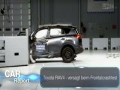
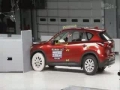
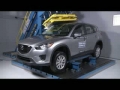
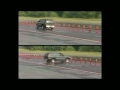
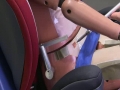
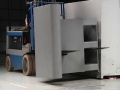
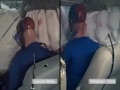
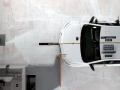
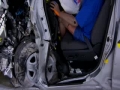
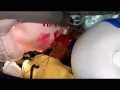
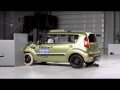
Obwohl Toyota bei seinem RAV4 des Modelljahrgangs 2013 zumindest in der USA-Version - in den Bereichen Lenksäule und Fußraum das neue Modell nachgebessert hat, ist es beim von dem anerkannten amerikanischen Insurace Insitute für Highway Safety (IIHS) durchgeführten Frontalcrasch mit kleiner Überlappung durchgefallen. Mit dem Crash, bei dem mit einer Geschwindigkeit von 40 Meilen (64,37 km/h) 25 Prozent der Front auf eine Barriere treffen, werden die Auswirkungen eines Unfalls simuliert, bei dem zwei Fahrzeuge mit ihren Frontecken zusammenstoßen beziehungsweise das Auto auf einen Baum prallt. Ein sehr realistischer Test, den das Institut erst seit vergangenem Jahr zu seinen vier anderen Crashformen – moderate Überlappung der Front, Seite, Überschlag und Heck – hinzugefügt hat und inzwischen mit der „moderaten Überlappung“ zusammen als wichtigsten Test ansieht. Der – wegen der Nachbesserungen des Herstellers – extra verschoben, verlief nun alles andere als erfolgreich. Laut IIHS wurde die Karosserie-Struktur schwer beschädigt und drang teilweise in den Fußraum, so dass auch der linke Fuß des Fahrers – wenn es kein Dummy gewesen wäre – verletzt worden wäre. Darüber hinaus zeigte sich der Frontal-Airbag als „nutzlos“, da die Lenksäule durch den Aufprall nach rechts gebogen wurde und der Kopf des Dummys kaum geschützt wurde. Und obendrein arbeitete der Sicherheitsgurt nicht korrekt, so das Kopf und Oberkörper auf das Armaturenbrett prallten. Auch wenn der RAV4bei den anderen vier Crashtest überall mit der Note „Gut“ abgeschnitten hatte, gab es nur ein Urteil: Schlecht.
Today, the Television Bureau of Advertising (TVB), the not-for-profit trade association of America’s commercial broadcast television industry, the National Highway Traffic Safety Administration (NHTSA), and the Ad Council launched their 11th year of “Project Roadblock: Local TV Puts the Brakes on Drunk Driving.” Launched in December 2003, Project Roadblock is the local broadcast television industry’s extension of NHTSA and the Ad Council’s ‘Buzzed Driving is Drunk Driving’ PSA campaign. Since then, the multi-media campaign has served as an opportunity for local television stations to combat drunk driving by donating on-air, online and mobile advertising time and space for the PSAs. To date, broadcast TV stations across the nation have donated more than $34 million in media to support this effort.
To view the Multimedia News Release, go to http://www.multivu.com/players/English/7391951-ad-council-tvb-nhtsa-partner-to-prevent-drunk-driving-fatalities-during-holidays/
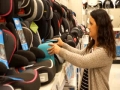
Thirteen out of 16 new booster seats for 2017 earn the Insurance Institute for Highway Safety's highest rating of BEST BET, bringing the total number of boosters on the market with that designation to 118.
The BEST BET rating means a booster provides good safety belt fit for typical 4 to 8 year-olds in almost any car, minivan or SUV. Boosters that are rated GOOD BETs provide acceptable belt fit in almost any vehicle, while those rated Check Fit could work for some children in some vehicles. Seats designated "Not Recommended" don’t provide good belt fit and should be avoided.
Just over half of 2018 model vehicles evaluated by the Insurance Institute for Highway Safety are available with headlights that do an adequate job of lighting the road at night and limiting glare for oncoming drivers, but most good-rated headlights are optional or bundled with other features that can raise the price of the vehicle.
Since IIHS released its first headlight ratings for passenger vehicles in 2016, most manufacturers have focused on improving this key safety component. That year, only 2 of 95 headlight systems on 2016-model vehicles evaluated earned a good rating.
For the 2018 model year, the best-available headlights on 32 of 165 models evaluated earn the highest rating of good, and the best-available headlights on 58 models earn the second-highest rating of acceptable. Thirty-two models have only marginal-rated headlights, while poor-rated headlights are the only ones available for 43 models.
Twenty-two vehicles earn the Insurance Institute for Highway Safety's highest safety award for 2014, TOP SAFETY PICK+, thanks to a high level of protection in crashes and the availability of front crash prevention technology to avoid many collisions in the first place. An additional 17 earn TOP SAFETY PICK by meeting the crashworthiness criteria alone.
IIHS is using new criteria for the awards this year. TOP SAFETY PICK requires good performance in the Institute's moderate overlap front, side, roof strength and head restraint tests and, for the first time, good or acceptable performance in the small overlap front test introduced in 2012. The same level of performance in those tests, along with at least a basic rating for front crash prevention, is required for the higher accolade, TOP SAFETY PICK+.
When IIHS began its booster seat ratings in 2008, most models failed to consistently provide good belt fit — the main purpose of a booster. This year, all new models evaluated by the Institute provide good or acceptable fit for typical 4 to 8 year-olds in most cars, minivans or SUVs.
Out of 23 new models evaluated, 20 earn the highest rating of BEST BET, meaning they are likely to provide good fit for a 4- to 8-year-old child in almost any car, minivan or SUV. Another three models are rated GOOD BETs, meaning they provide acceptable fit in most vehicles. There are no new models in the Not Recommended category, nor are there any with the Check Fit designation, which identifies seats that may work for some children in some vehicles.
Nearly 50 vehicles meet tougher criteria for 2016 to take home the Insurance Institute for Highway Safety’s TOP SAFETY PICK+ award, earning good ratings in all five IIHS crashworthiness evaluations and an advanced or higher rating for front crash prevention. An additional 13 models qualify for TOP SAFETY PICK.
The baseline requirements for both awards are good ratings in the small overlap front, moderate overlap front, side, roof strength and head restraint tests, as well as a standard or optional front crash prevention system. The 48 winners of the “plus” award have a superior- or advanced-rated front crash prevention system with automatic braking capabilities. These vehicles must stop or slow down without driver intervention before hitting a target in tests at 12 mph, 25 mph or both. Models with a basic-rated front crash prevention system, which typically only issues a warning and doesn’t brake, qualify for TOP SAFETY PICK.
IIHS inaugurated TOP SAFETY PICK in the 2006 model year to help consumers home in on vehicles with the best safety performance. The TOP SAFETY PICK+ accolade was introduced in 2012 to recognize vehicles that offer an advanced level of safety.
A new crash test program from the Insurance Institute for Highway Safety aims to ensure that manufacturers pay attention to the safety of front passengers as well as drivers.
The test was developed after it became clear that some manufacturers were giving short shrift to the right side of the vehicle when it comes to small overlap front crash protection. A good or acceptable passenger-side rating will be required to qualify for the Institute’s 2018 TOP SAFETY PICK+ award.
The first test group in the passenger-side small overlap front test program did better overall than vehicles IIHS previously evaluated for research. Ten out of 13 midsize cars tested earn a good rating, while one is acceptable and two earn a marginal rating.
In contrast with a group of 2014-16 model small SUVs tested for research, none of the 2017-18 midsize cars had a poor or marginal structural rating. Instead, the biggest problem in the new group was inconsistent airbag protection in five cars, which would put passengers’ heads at risk.
Not a single small SUV out of 21 tested earns a good rating in the Insurance Institute for Highway Safety’s headlight evaluations, and only four are available with acceptable-rated headlights.
Among the 21 vehicles, there are 47 different headlight combinations available. More than two-thirds of them are rated poor, making this group of vehicles even more deficient when it comes to lighting than the midsize cars that were the first to be rated earlier this year.
Headlight performance in today’s vehicles varies widely. Government standards are based on laboratory tests, which don’t accurately gauge performance in real-world driving. The issue merits attention because about half of traffic deaths occur either in the dark or around dawn or dusk.
As with midsize cars, the IIHS evaluations of small SUVs showed that a vehicle’s price tag doesn’t correspond to the quality of headlights. More modern lighting types, including high-intensity discharge (HID) and LED lamps, and curve-adaptive systems, which swivel in the direction of steering, also are no guarantee of good performance.
Three out of seven large pickup trucks evaluated by the Insurance Institute for Highway Safety in a new round of crash tests earn an acceptable or higher rating for occupant protection in a small overlap front crash.
IIHS evaluated two body styles of each 2016 model-year pickup — crew cab and extended cab. Crew cabs have four full doors and two full rows of seating. Extended cabs have two full front doors, two smaller rear doors and compact second-row seats.
IIHS last year decided it would test the two most popular variants of large pickups instead of just one after discovering that the Ford F-150 extended cab lacked structural countermeasures that helped the crew cab earn the top rating of good in the small overlap test. The test replicates what happens when a vehicle runs off the road and hits a tree or pole or clips another vehicle that has crossed the center line.
Ford improved the 2016 model F-150 SuperCab to clinch a good rating in the small overlap crash test, up from the 2015 model’s marginal rating. The F-150 is the only large pickup in the latest test group to earn the Institute’s top rating in the test. It joins the F-150 SuperCrew in earning a 2016 TOP SAFETY PICK award when equipped with Ford’s optional basic-rated forward collision warning system.
Vehicles that earn a basic rating for front crash prevention plus good ratings in the small overlap front, moderate overlap front, side, roof strength and head restraint evaluations qualify for TOP SAFETY PICK. To qualify for 2016 TOP SAFETY PICK+, a vehicle must earn good ratings in the five crashworthiness tests and an advanced or superior rating for front crash prevention.
Last December, nearly one-third of all car crash fatalities involved a drunk driver, according to the U.S. Department of Transportation’s National Highway Traffic Safety Administration (NHTSA). Today, to help make our roads safer during the holiday season, the Television Bureau of Advertising (TVB) launched the 13th annual “Project Roadblock” initiative, in which local broadcast TV stations donate airtime to support NHTSA and the Ad Council’s “Buzzed Driving is Drunk Driving” PSA (public service advertising) campaign.
To help the campaign’s message reach those who could benefit most, the Ad Council is conducting a special push to TV stations in the 10 states that accounted for 53% of all alcohol-impaired driving fatalities in 2015: Texas, California, Florida, North Carolina, Georgia, Pennsylvania, Ohio, New York, Illinois, and South Carolina.
To view the multimedia release go to:
http://www.multivu.com/players/English/8003951-nhtsa-ad-council-tvb-anti-drunk-driving-psa/
The latest small overlap front crash test results from the Insurance Institute for Highway Safety (IIHS) reveal a range of performance among many of the best-selling small cars in the U.S. market. Of the 12 models evaluated, half earn a good or acceptable rating and qualify for the IIHS TOP SAFETY PICK+ award.
The 2-door and 4-door models of the Honda Civic are the only small cars to earn the top rating of good in the test. IIHS evaluated the Civics earlier this year and released the results in March. The Dodge Dart, Ford Focus, Hyundai Elantra and 2014 model Scion tC earn acceptable ratings.