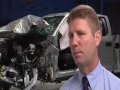
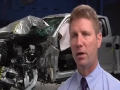
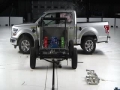
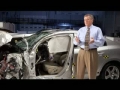
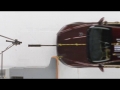
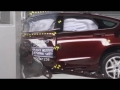
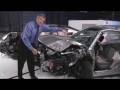
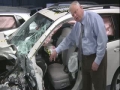
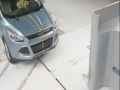
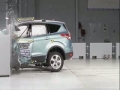
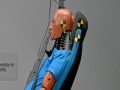
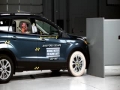
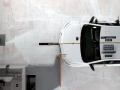
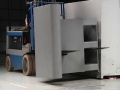
The aluminum-body 2015 Ford F-150 crew cab swept the Insurance Institute for Highway Safety’s full slate of crashworthiness evaluations to qualify for a 2015 TOP SAFETY PICK award. The F-150 extended cab turned in a good performance in 4 of 5 assessments but stumbled in the small overlap front test. The results are the first ratings for large pickups in a group the Institute is evaluating this year.
The F-150 crew cab, which Ford calls the SuperCrew, earns good ratings for occupant protection in all five IIHS crashworthiness evaluations — small overlap front, moderate overlap front, side, roof strength and head restraint evaluations. The extended cab, or SuperCab, earns good ratings in the moderate overlap front, side, roof strength and head restraint evaluations but just a marginal rating for occupant protection in a small overlap front crash.
Only 3 of 11 midsize luxury and near-luxury cars evaluated earn good or acceptable ratings in the Insurance Institute for Highway Safety’s new small overlap frontal crash test, the latest addition to a suite of tests designed to help consumers pick the safest vehicles.
A group of moderately priced midsize cars outperformed most of their luxury counterparts in a challenging new frontal crash test conducted by the Insurance Institute for Highway Safety (IIHS) on 2013 models. Of the 18 midsize family cars evaluated in the small overlap test, two earn the top rating of good, 11 earn acceptable, three earn marginal, and two are poor.
In contrast, just 3 of 11 midsize luxury and near-luxury cars evaluated in the inaugural round of small overlap tests earned good or acceptable ratings. Midsize moderately priced cars are the second group to be tested. The best performers in this group are the Honda Accord 4-door and Suzuki Kizashi. Both earn a good rating.
The 2014 Subaru Forester is the first vehicle to ace every aspect of the challenging small overlap front crash test conducted by the Insurance Institute for Highway Safety (IIHS). The Forester, the only 1 of 13 small SUVs to earn an overall rating of good in the test, and the 2013 Mitsubishi Outlander Sport, which earns acceptable, are the latest vehicles to qualify for the Institute’s recently inaugurated top honor, TOP SAFETY PICK+. Each of the other 11 SUVs earns either a poor or marginal rating.
Two all-electric vehicles fall short of meeting the Insurance Institute for Highway Safety’s awards criteria, but consumers who want to minimize gas consumption while also prioritizing safety can choose from two plug-in hybrids that earn the 2017 TOP SAFETY PICK+ award.
The two recently evaluated all-electric models are the 2017 Tesla Model S and the 2017 BMW i3. The plug-in hybrid models are the Chevrolet Volt, whose award was announced in December, and the Toyota Prius Prime.
To qualify for the 2017 TOP SAFETY PICK award, a vehicle must earn good ratings in all five crashworthiness evaluations — small overlap front, moderate overlap front, side, roof strength and head restraints — and come with a front crash prevention system that earns an advanced or superior rating. The “plus” is awarded to vehicles that meet all those criteria and also come with good or acceptable headlights.
In a new round of evaluations, 5 of 7 small SUVs earn good ratings from the Insurance Institute for Highway Safety for occupant protection in a passenger-side small overlap front crash.
The ratings bring to 16 the number of small SUVs the Institute has evaluated in the passenger-side small overlap front test, which was introduced in 2017 to encourage manufacturers to offer the same level of protection for front-seat passengers as drivers in this type of crash.
The BMW X1; Chevrolet Equinox and its twin, the GMC Terrain; Jeep Compass and Mitsubishi Outlander earn good ratings in the passenger-side small overlap front test. The Mitsubishi Outlander Sport earns a marginal rating, and the Ford Escape earns poor. For the 2018 model year, the Equinox shed weight to join the small SUV size class. Earlier models were classified as midsize.
None of the newly rated 2018 models earns better than acceptable marks for structure. (The Honda CR-V and Mazda CX-5 are the only small SUVs evaluated so far to earn good ratings for structure in the passenger-side small overlap front test.) The Outlander Sport is marginal, and the Escape is rated poor. Both the Outlander Sport and Escape allowed too much intrusion into the occupant compartment on the right side.
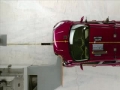
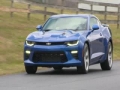
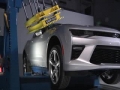
Think “muscle car” performance, and images of speed and power are more likely to come to mind than crash tests and safety ratings. Because no one buys a sports car to drive in the slow lane, the best all-¬ around occupant crash protection is crucial. The Insurance Institute for Highway Safety (IIHS) recently put a trio of iconic sports coupes through their paces, and unlike more sedate sedans, none earns the scores needed to clinch a TOP SAFETY PICK award.
IIHS evaluated 2016 models of the Chevrolet Camaro, Dodge Challenger and Ford Mustang in the full battery of crashworthiness evaluations. The Mustang comes closest to earning TOP SAFETY PICK, while the Camaro falls shortin one category and lacks an available front crash prevention system. The Challenger is most in need of improvement.
To qualify for TOP SAFETY PICK, vehicles must earn good ratings in the small overlap front, moderate overlap front, side, roof strength and head restraint evaluations and have a basic-¬rated front crash prevention system. To qualify for the Institute’s highest award, TOP SAFETY PICK+, vehicles must earn good ratings in the five crashworthiness tests and an advanced or superior rating for front crash prevention.
Nearly five dozen 2019 models meet stricter criteria to qualify for a 2019 TOP SAFETY PICK+ or TOP SAFETY PICK award from the Insurance Institute for Highway Safety. The 30 first-tier “plus” award winners earn the highest rating for passenger-side protection in a small overlap front crash and have good-rated available headlights, while the 27 winners of the second-tier award qualify with an acceptable or higher rating in the newest IIHS crash test and the nighttime headlight evaluation.
All 57 vehicles in this elite group earn good ratings in the Institute’s five other crashworthiness evaluations and have an available automatic emergency braking system that rates advanced or superior for front crash prevention.
IIHS now requires a good rating in the passenger-side small overlap front test to earn a 2019 TOP SAFETY PICK+ versus an acceptable or good rating for the 2018 award. An acceptable or good rating in the passenger-side test is a new criterion to earn a 2019 TOP SAFETY PICK.
This marks the sixth time that IIHS has raised the bar to earn the TOP SAFETY PICK+ award since introducing it in the 2013 model year to recognize vehicles that offer a superior level of safety. The TOP SAFETY PICK accolade launched in the 2006 model year to help consumers identify vehicles with the highest ratings. Over the years, IIHS has added to and strengthened criteria for both awards to encourage manufacturers to speed up safety advances.
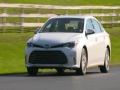
The Lincoln Continental, the Mercedes-Benz E-Class and the Toyota Avalon come out at the top of a group of six large cars recently evaluated by the Insurance Institute for Highway Safety.
The three cars qualify for TOP SAFETY PICK+, the Institute’s highest award. The Tesla Model S, the Chevrolet Impala and the Ford Taurus fall short of any award because they each earn only an acceptable rating in the small overlap front test.
Vehicles qualify for either the TOP SAFETY PICK or TOP SAFETY PICK+ award if they have good ratings from IIHS in five crashworthiness tests — small overlap front, moderate overlap front, side, roof strength and head restraints — and an available front crash prevention system that earns a superior or advanced rating. To qualify for TOP SAFETY PICK+, a vehicle also must come with good or acceptable headlights
Twenty-two vehicles earn the Insurance Institute for Highway Safety's highest safety award for 2014, TOP SAFETY PICK+, thanks to a high level of protection in crashes and the availability of front crash prevention technology to avoid many collisions in the first place. An additional 17 earn TOP SAFETY PICK by meeting the crashworthiness criteria alone.
IIHS is using new criteria for the awards this year. TOP SAFETY PICK requires good performance in the Institute's moderate overlap front, side, roof strength and head restraint tests and, for the first time, good or acceptable performance in the small overlap front test introduced in 2012. The same level of performance in those tests, along with at least a basic rating for front crash prevention, is required for the higher accolade, TOP SAFETY PICK+.
A new crash test program from the Insurance Institute for Highway Safety aims to ensure that manufacturers pay attention to the safety of front passengers as well as drivers.
The test was developed after it became clear that some manufacturers were giving short shrift to the right side of the vehicle when it comes to small overlap front crash protection. A good or acceptable passenger-side rating will be required to qualify for the Institute’s 2018 TOP SAFETY PICK+ award.
The first test group in the passenger-side small overlap front test program did better overall than vehicles IIHS previously evaluated for research. Ten out of 13 midsize cars tested earn a good rating, while one is acceptable and two earn a marginal rating.
In contrast with a group of 2014-16 model small SUVs tested for research, none of the 2017-18 midsize cars had a poor or marginal structural rating. Instead, the biggest problem in the new group was inconsistent airbag protection in five cars, which would put passengers’ heads at risk.
Nearly 50 vehicles meet tougher criteria for 2016 to take home the Insurance Institute for Highway Safety’s TOP SAFETY PICK+ award, earning good ratings in all five IIHS crashworthiness evaluations and an advanced or higher rating for front crash prevention. An additional 13 models qualify for TOP SAFETY PICK.
The baseline requirements for both awards are good ratings in the small overlap front, moderate overlap front, side, roof strength and head restraint tests, as well as a standard or optional front crash prevention system. The 48 winners of the “plus” award have a superior- or advanced-rated front crash prevention system with automatic braking capabilities. These vehicles must stop or slow down without driver intervention before hitting a target in tests at 12 mph, 25 mph or both. Models with a basic-rated front crash prevention system, which typically only issues a warning and doesn’t brake, qualify for TOP SAFETY PICK.
IIHS inaugurated TOP SAFETY PICK in the 2006 model year to help consumers home in on vehicles with the best safety performance. The TOP SAFETY PICK+ accolade was introduced in 2012 to recognize vehicles that offer an advanced level of safety.